
Lithium-ion batteries are now in almost every Indian home and building: the e-scooter charging in the parking, the inverter with a lithium pack, the solar storage on the terrace, the power bank in a bag, the laptop on the bed. They are safe almost all the time. When one does fail, it fails in a way that ordinary fire safety does not expect: the fire feeds itself, gives off toxic smoke and can flare up again minutes or hours after it looks out.
This guide explains why a lithium battery fire is different, what to do in the first minute, which extinguisher actually works on it in India, and what a home, a housing society parking, an office or an EV showroom should keep.
Why a lithium battery fire is different
A lithium-ion cell stores a lot of energy in a small space. If it is damaged, overcharged, badly made or overheated, one cell can go into thermal runaway: it heats itself, breaks down and releases flammable gas and its own oxygen. The heat then pushes the next cell over the edge, and the next. That is why a battery pack burns in bursts, with jets of flame and popping, and why it can relight after the visible flames have gone.
Three things follow from this:
- Smothering is not enough. CO2 and dry powder push the oxygen away, but the cells make their own. The flames die down and come back once the agent clears.
- Cooling is what stops it. To break the chain you have to bring the cells below the temperature at which the next one runs away.
- The smoke is dangerous. Burning cells give off toxic and corrosive gases. Never stand over a battery fire in a closed room.
Warning signs before a battery fire
- The battery or charger is much hotter than usual to touch.
- The pack is swollen, bulging or the casing has cracked.
- A hissing or popping sound, or a sweet chemical smell.
- White or grey smoke from the battery, scooter floorboard or inverter.
If you notice any of these, unplug the charger at the wall if it is safe to reach, move people away and keep a lithium-ion extinguisher ready. Do not try to carry a hot, smoking battery out of the building.
What to do in the first minute
- Cut the power to the charger at the switch or MCB, if you can do it without going near the fire.
- Get people out of the room or parking area and away from the smoke. Close doors behind you.
- Call 101 for anything bigger than a phone or power bank. Tell them it is a battery or EV fire.
- Use a lithium-ion extinguisher from a safe distance, aimed at the battery, and keep applying it until the pack stops hissing and flaring.
- Watch it. A pack that looks out can reignite. Keep the area clear and keep checking for at least an hour; the fire service may move the vehicle or pack to an open area.
Which extinguisher works on a lithium battery fire
1. Lithium-ion extinguisher: the one made for it
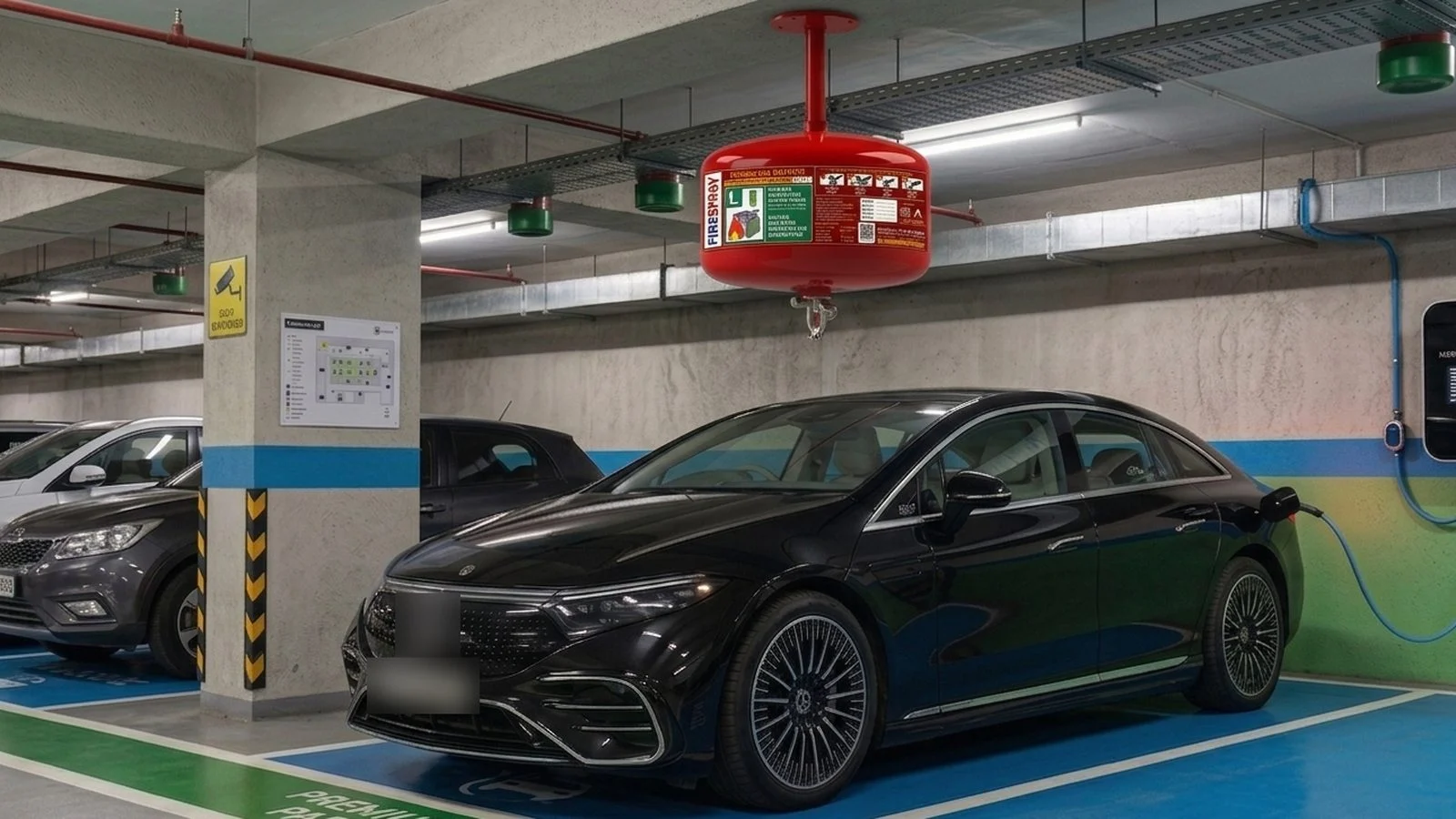
A lithium-ion fire extinguisher uses a water-based agent made for battery fires. It cools the cells, wets the pack and helps stop the chain reaction from jumping cell to cell, which is what prevents re-ignition. FireSpray makes it in two bodies: the red mild steel lithium-ion extinguisher for parking, plant and EV charging areas, and the stainless steel lithium battery extinguisher for showrooms, electronics shops, offices and damp battery rooms. Both come in 1 L to 9 L sizes.
Its label is clear about its limits: it is made for lithium-ion battery fires. It is not for metal fires (Class D), and it is not meant as the general extinguisher for wood, paper or cloth fires that have nothing to do with a battery. Keep it next to the charger or battery, and an ABC unit nearby for everything else.
2. ABC dry powder: for what catches fire around the battery
An ABC extinguisher will knock down the flames from a burning scooter seat, tyres, plastic panels or a cupboard around an inverter. It will not cool the cells, so on the battery pack itself the fire usually comes back. Use it to stop the fire spreading, not as the answer to the battery.
3. CO2 and clean agent: good for electrical, weak on a pack in runaway
CO2 and clean agent units are the right choice next to an electrical panel or a lead-acid UPS. On a lithium pack in thermal runaway they act for a few seconds and then the cells, still hot, flare again. In a small room a full CO2 discharge also displaces breathable air.
4. Water, sand and fire blankets
Large amounts of water are what fire services use to cool an EV battery once the power is cut, but a mug or a small hose from a person standing close is not enough and puts them in the smoke. Sand or a fire blanket can cover a small device such as a phone or power bank and stop flames spreading, but neither cools the cells. For a phone, power bank or laptop that has caught fire, the safest move is often to get it onto a non-flammable floor away from anything else and let a lithium-ion extinguisher or the fire service deal with it.
Lithium battery fire: extinguishers compared
| Type | On the battery pack | On things burning around it | Notes |
|---|---|---|---|
| Lithium-ion extinguisher | Yes, made for it; cools the cells | Not its job | Keep next to chargers and battery rooms |
| ABC dry powder | Knocks flames down, pack relights | Yes | Stops spread; messy cleanup |
| CO2 | Brief effect, pack relights | Electrical and liquid fires | Right for panels and lead-acid UPS |
| Clean agent | Brief effect, pack relights | Yes, with no residue | Right for server and control rooms |
| Sand or fire blanket | Covers small devices only | Small flames | Does not cool the cells |
What to keep where
| Place | Keep | Where |
|---|---|---|
| Home with an e-scooter or inverter | 2 L lithium-ion extinguisher and a 2 or 4 kg ABC | Lithium unit near the charging point or inverter; ABC near the kitchen door |
| Housing society parking with EV chargers | 4 or 6 L lithium-ion unit at each charging cluster, ABC in each parking level | On the pillar beside the chargers, never behind the parked vehicles |
| Office UPS room, telecom shelter | Stainless steel lithium unit at the door, CO2 for the panel | Outside or just inside the door |
| EV and e-bike showroom, service centre | 6 or 9 L lithium-ion units in the workshop and display, ABC in the sales area | Next to every charging and repair bay |
| Solar battery storage | Stainless steel lithium unit (damp, outdoor-facing rooms) | At the battery room door |
| Phone and laptop shop | 2 L stainless steel lithium unit at the counter and repair desk | Within reach of the repair bench |
For a housing society, battery cover in the parking belongs in the same plan as the floor-wise units; see the fire extinguisher plan for housing societies.
Seven habits that prevent most battery fires
- Use the charger that came with the vehicle or device, or a certified replacement. Cheap chargers are a leading cause of e-scooter fires.
- Do not charge e-scooters inside the flat, in a passage or in the only exit route; charge in a ventilated parking bay.
- Do not charge overnight unattended where a fire would trap people.
- Let a battery cool after a ride before charging, and keep it out of direct afternoon sun.
- Stop using any battery that is swollen, dented, wet or has been dropped hard.
- Keep inverters and battery packs on a stand with space around them, never inside a closed wooden cupboard.
- Do not charge phones and power banks on a bed, sofa or pillow.
Frequently asked questions
Which fire extinguisher is used for lithium battery fires?
A lithium-ion fire extinguisher, which uses a water-based agent that cools the cells and helps stop re-ignition. CO2 and dry powder only knock the flames down for a short time because the cells keep producing heat and their own oxygen.
Can an ABC fire extinguisher put out a lithium battery fire?
It can put out the plastic, seat or cupboard burning around the battery, but it does not cool the cells, so the battery pack usually reignites. Keep a lithium-ion extinguisher next to chargers and use the ABC to stop the fire spreading.
Why do EV and e-scooter batteries catch fire again?
Because of thermal runaway: a failing cell heats the cells next to it, and each one releases heat, flammable gas and oxygen. Unless the pack is cooled, the chain keeps going after the flames have gone.
Can I use water on a lithium battery fire?
Large amounts of water used by the fire service help cool an EV pack once the power is off. A small amount of water from close by is not enough and puts you in toxic smoke. Cut the power, get people out, call 101 and use a lithium-ion extinguisher from a safe distance.
Which extinguisher should a housing society keep near EV chargers?
A 4 or 6 L lithium-ion extinguisher at each charging cluster, mounted on the pillar beside the chargers, with an ABC extinguisher on each parking level for other fires.
Is the lithium-ion extinguisher good for all fires?
No. It is made for lithium-ion battery fires and is not for metal (Class D) fires. For general fires in wood, paper, cloth or LPG, keep an ABC extinguisher as well.
Standards referenced: IS 2190 and IS 15683 from the Bureau of Indian Standards. In an emergency, call the fire service on 101.
Planning chargers for a society or office? Send the parking layout on WhatsApp and we will mark where each unit goes, or see every lithium fire extinguisher with live prices.