
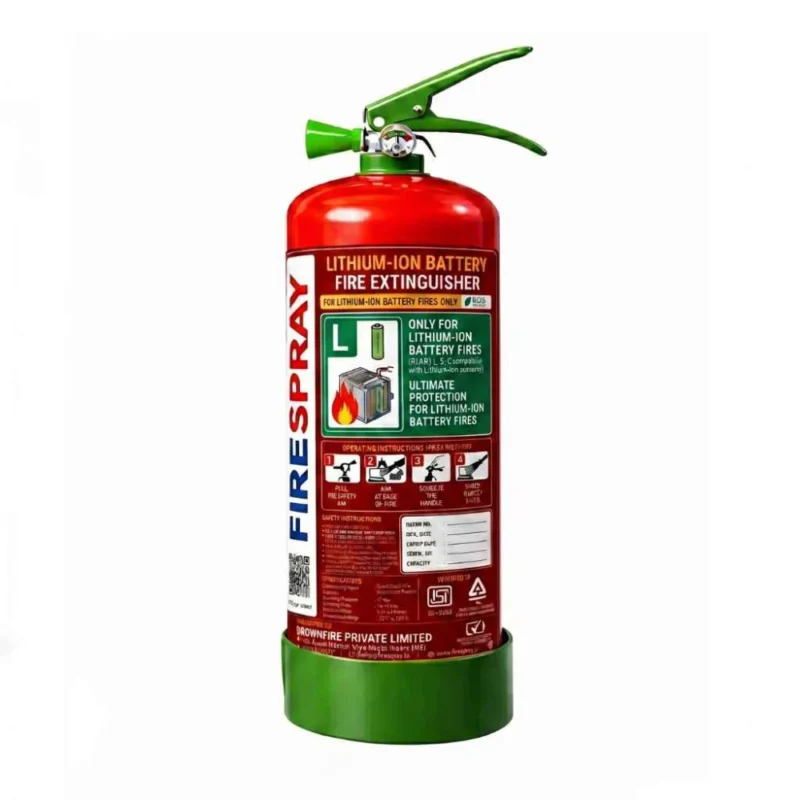
Lithium Fire Extinguisher
Download spec sheet (PDF)
Order on WhatsApp
Buying 10 or more? Get factory bulk price, a placement plan and free staff training →
Lithium Ion Fire Extinguisher – EV & Battery Safety Protection
Lithium Fire Extinguisher
Li-ion Original price was: ₹9,000.₹7,200Current price is: ₹7,200. + GST
Prices exclude GST. Freight charged extra as per delivery location.
Dispatch within 7 days · Pan-India delivery
5-year warranty from the invoice date
ISI marked, IS 15683:2018, pressure-tested before dispatch
10-day replacement for a manufacturing fault or transit damage
Pan-India delivery with GST invoice, freight extra
5-year warranty
Covered from the invoice date. If a unit fails, we replace it.
No yearly refills
Stays factory-sealed. Refill vs replace
ISI marked
Made to IS 15683:2018, pressure-tested before dispatch.
Free training
Live fire-safety demo with every bulk order.
Buy together
Complete your fire safety setup
Specifications
| Category | Lithium Fire Extinguisher |
|---|---|
| Sizes | 1 L, 2 L, 4 L, 6 L, 9 L |
| SKU | FS-LI-1L |
| Extinguishing agent | Lithium-battery agent |
| Standard | ISI marked, IS 15683:2018 (about BIS certification) |
| Warranty | 5 years from invoice date |
| Delivery | Pan-India, freight extra, GST invoice |
| Replacement | 10 days for a manufacturing fault or transit damage |
Product details
Lithium ion fire extinguisher for EV and battery safety
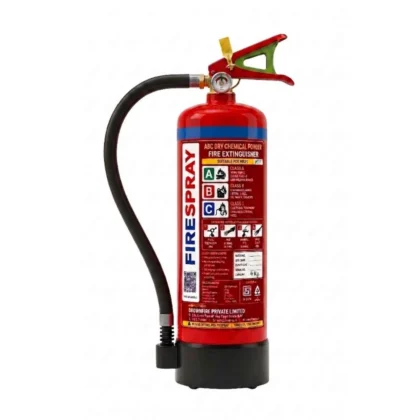
The FireSpray lithium ion fire extinguisher is our red-body unit made for one job: battery fires. Lithium-ion cells in EVs, e-bikes, inverters and UPS systems burn hot and can flare up again after the flames die down. This unit uses a special agent that cools the cells and helps stop re-ignition. It carries the ISI mark, is pressure-tested at our factory and has a 5-year warranty from the invoice date. Sizes run from 1 L to 9 L; select a size above to see its price (plus GST).
Where it is used
- EV charging points in apartments, malls and offices
- E-bike and e-scooter parking and showrooms
- UPS rooms, battery rooms and telecom shelters
- Solar battery storage at homes and plants
Battery risk is now present in ordinary buildings, not only factories, because almost every vehicle charger, inverter and backup system uses lithium-ion cells.
What not to use it on
The label is clear: this unit is for lithium-ion battery fires only. Do not use it on metal fires (Class D), and do not rely on it for general fires in wood, paper or cloth that have nothing to do with a battery. For the rest of the building, keep an ABC powder fire extinguisher on each floor. For a burning cooking pan, use a K-type kitchen extinguisher.
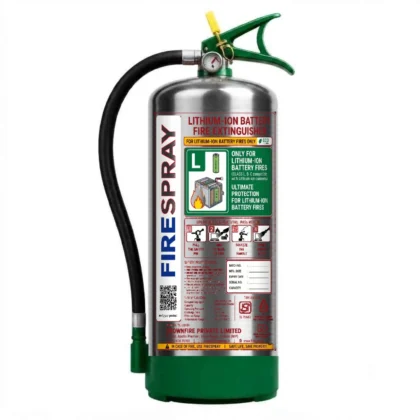
Red body or stainless steel?
| Point | This unit | Lithium battery (SS body) |
|---|---|---|
| Body | Red painted body | Stainless steel |
| Best for | Parking, charging bays, UPS and battery rooms | Electronics stores, data centres, damp or premium areas |
| Sizes | 1, 2, 4, 6, 9 L | 1, 2, 4, 6, 9 L |
For a corrosion-free finish, see the lithium battery fire extinguisher in stainless steel. Both are in the lithium fire extinguisher range.
Which size do I need?
| Size | Good for |
|---|---|
| 1 L, 2 L | Homes, cabins, e-bike in a flat, small shops |
| 4 L | Showrooms, offices, small UPS rooms |
| 6 L, 9 L | Parking areas, charging bays and battery rooms |
Specifications (as printed on our lithium-ion label)
| Use | Lithium-ion battery fires only |
|---|---|
| Operating pressure | 15 bar |
| Discharge time | 10 to 15 seconds |
| Effective range | 1.5 to 3 metres |
| Temperature range | -20 °C to +60 °C |
| Mark | ISI marked, BIS approved |
| Warranty | 5 years from the invoice date |
How to use it on a battery fire
- Pull the safety pin, holding the unit upright.
- Aim at the base of the fire, at the battery pack.
- Squeeze the handle.
- Sweep, drench and cool: keep applying the agent to cool the battery even after the flames are out.
Switch off the charger at the mains if it is safe to do so. Battery smoke is toxic, so avoid breathing it, keep an exit behind you and leave at once if the fire grows. Call the fire brigade even if the fire seems to be out.
Monthly check
Check that the gauge needle is in the green zone, the pin and seal are intact, and the body has no dents or rust. The unit stays factory-sealed, so there are no yearly refills; if a covered unit fails, we replace it. Read about refill vs replace.
EV charging sites and fleets
For 10 or more units we give factory pricing, a GST invoice, a placement plan as per IS 2190 and free fire-safety training, so staff know how to use a lithium ion fire extinguisher at a battery fire. Get a bulk quote or compare every model on the fire extinguisher price list.
You may also need
View all →More Lithium Fire Extinguisher options
FAQ
Questions buyers ask
Can't find your answer? Call or WhatsApp us on +91 72 4747 6161.
All questionsWhich fire extinguisher is used for an EV charging point?
A lithium ion fire extinguisher. Its agent cools the battery cells and helps stop the fire flaring up again, which powder or plain water cannot do well.
Can I use it on an ordinary fire in wood or paper?
No. It is made for lithium-ion battery fires only. Keep an ABC extinguisher for general fires in the building.
Why keep spraying after the flames are out?
Lithium-ion cells can stay hot and re-ignite. Keep applying the agent to cool the battery, then call the fire brigade.
Which size suits an e-bike kept at home?
A 1 L or 2 L unit is easy to keep near the charging point. Use 6 L or 9 L for parking areas and battery rooms.
Can an ABC extinguisher put out an EV battery fire?
It may knock down flames but cannot cool the cells; a lithium-ion extinguisher is designed for battery fires.
Trusted by industry