
Every petrol pump, paint shop, generator room and garage in India has one thing in common: the fire that starts there will not be a pile of burning paper. It will be a spill of petrol, diesel, thinner or oil, and that is a Class B fire. It spreads as fast as the liquid flows, it flashes back the moment the vapour finds the flame again, and the water bucket on the wall will make it worse, not better.
This guide covers what counts as a Class B fire under the Indian standard IS 2190, which extinguishers are rated for it, how to read the “B” number on the label, and what a garage, pump, godown or society generator room should actually keep on the wall.

What is a Class B fire?
IS 2190 defines Class B as fires in flammable liquids and liquefiable solids. In plain words, anything that burns as a liquid or melts and then burns like one:
- Petrol, diesel, kerosene, aviation fuel
- Paint, varnish, thinner, turpentine and other solvents
- Lubricating oil, hydraulic oil, transformer oil, gear oil
- Alcohol, acetone, ethanol-based sanitiser in bulk
- Grease, wax, tar, bitumen and some plastics once molten
Two things are commonly mistaken for Class B. Cooking oil in a fryer or kadhai is Class F in India, not B, and needs a wet chemical extinguisher. LPG and other gases are Class C, covered in our Class C fire extinguisher guide. Both are liquids or near-liquids, which is why people file them under B, but the extinguisher that works is different in each case.
Why you cannot use water on a liquid fire
Petrol and oil float on water. Throw a bucket on a burning tray of diesel and the water sinks, the burning fuel rides on top of it and spreads across the floor. If the liquid is hot enough, the water flashes to steam and throws burning droplets outward, which is how a small spill becomes a room fire. That is also why the water type extinguisher carries an “A only” rating and a crossed-out B symbol on its label.
A Class B agent has to do one of two things instead: seal the surface so the vapour cannot reach the flame, or break the chemical reaction in the flame itself.
Extinguishers rated for Class B fires
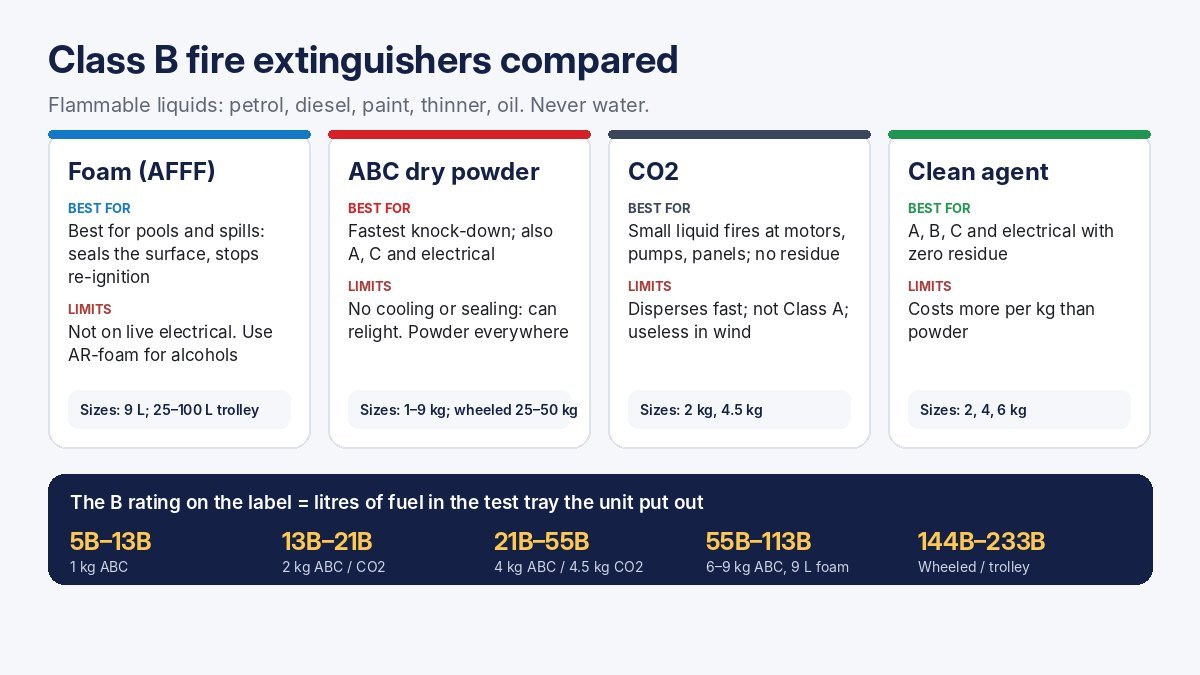
1. Foam (AFFF or mechanical foam): the Class B specialist
Aqueous film-forming foam is water with a concentrate that spreads a thin film across the burning liquid. The film floats, seals in the vapour and cools the fuel underneath. Because the foam stays on the surface after the flame is out, a foam-extinguished spill is far less likely to re-ignite than one knocked down with powder.
Foam is the right choice wherever there is a quantity of liquid that can pool: petrol pump forecourts, diesel storage, paint and thinner stores, transformer yards, workshops with oil pits. A 9 litre portable foam extinguisher handles a spill the size of a car bonnet; a 25 to 50 litre wheeled trolley unit is what a fuel depot or large factory keeps for a tank or tanker incident. Foam is also rated for Class A, so a garage with wooden racks and rags gets both covered by one unit.
Limits: foam is mostly water, so it must never be used on live electrical equipment. Ordinary AFFF also breaks down on alcohols and other polar solvents such as ethanol, acetone and IPA; a distillery, pharma plant or sanitiser store needs alcohol-resistant (AR-AFFF) foam.
2. ABC dry powder: the all-rounder with a strong B rating
The ABC extinguisher that hangs in most Indian buildings is rated B as well as A and C. Mono ammonium phosphate powder interrupts the chain reaction in the flame, and it works fast: a 6 kg unit will knock down a burning drum of oil in seconds. It is also safe on electrical equipment, which foam is not, so a generator room that has both diesel and a live panel is usually protected by ABC powder.
Limits: powder does not cool or seal the liquid. If the oil is still hot and there is a source of ignition nearby, the fire can relight after the powder settles, so stand ready for a second discharge. The powder also coats everything in the room. For a larger pool, a foam unit or a wheeled ABC unit rated 144B or higher is the better tool.
3. CO2: for small liquid fires next to electrics
Carbon dioxide pushes the oxygen away from the fire and leaves nothing behind. A 4.5 kg CO2 extinguisher is ideal for a small Class B fire on or around a machine, pump motor, lathe or control panel, where powder would mean a day of cleaning. It is the standard pairing for a generator room: ABC for the diesel, CO2 for the panel.
Limits: the gas disperses quickly, so it is for small, contained fires, not for a spreading spill. It is not rated for Class A at all. Outdoors in wind, a CO2 cloud blows away before it does its job.
4. Clean agent: Class B protection without any residue
A clean agent extinguisher (HFC-236fa or similar) is rated A, B and C and safe on electrical equipment, and it evaporates completely. It costs more per kg than powder, so it is chosen where the equipment matters more than the fire: a lab with solvents, a printing press with inks and thinners, a CNC shop, a vehicle paint booth with electronics in it.
How to read the B rating on the label
Every ISI-marked extinguisher carries a fire rating under IS 15683, written like 2A 21B or 55B or 144B. The number before the B is the size of the test fire the unit put out: a steel tray holding that many litres of fuel (in the test, two thirds heptane on one third water). So a 21B extinguisher put out a 21 litre tray fire; a 144B unit put out a 144 litre one. The rating, not the weight, tells you what the unit can do:
| Typical unit | B rating you will see | Roughly what it handles |
|---|---|---|
| 1 kg ABC (car) | 5B to 13B | A small spill, a two-wheeler engine fire |
| 2 kg ABC or 2 kg CO2 | 13B to 21B | A machine or a bucket-sized spill |
| 4 kg ABC or 4.5 kg CO2 | 21B to 55B | A drum, a small engine room |
| 6 kg or 9 kg ABC, 9 L foam | 55B to 113B | A spread of a few square metres, a car fire |
| 25 to 50 kg wheeled ABC, 45 L foam trolley | 144B to 233B | A tank bund or vehicle bay while the brigade arrives |
Two units that look identical can carry different ratings because the powder grade and the valve differ. MAP 90 powder gives a higher rating than MAP 40 in the same cylinder, which is one reason the price of two “4 kg ABC” units can be different.
What to keep where
- Petrol pump: the oil company’s licence conditions and the OISD standard for retail outlets spell out the count. In practice that means 9 kg DCP units at each dispenser island and the tank area, foam units for the unloading bay, and a sand bucket stand. Ask the company’s safety officer for the exact list before an audit.
- Car or two-wheeler garage: a 9 litre foam near the service bay, 6 kg ABC at the exit, 4.5 kg CO2 at the electrical panel and compressor.
- Generator or DG room: 6 kg ABC at the door and 4.5 kg CO2 at the control panel. A ceiling-mounted modular unit above the set covers the hours when nobody is around.
- Paint, thinner or chemical store: foam, alcohol-resistant if solvents are polar, plus ABC at the door. Keep the units outside the store, next to the entrance, so you are not walking into the fire to reach them.
- Housing society: the DG room and the car park are the Class B spots. A 6 kg ABC and a 4.5 kg CO2 at the DG room, and ABC units in the parking so nobody has to walk more than 15 metres.
- Factory with oil or fuel: a site visit beats a guess. Tell us what is stored and in what quantity and we will work out a floor plan that an auditor will accept.
Using an extinguisher on a liquid fire
Liquid fires need a slightly different technique from the standard PASS method. Start further back, 2 to 3 metres, and aim at the near edge of the burning liquid, not the middle. A hard jet into the centre of a tray splashes burning fuel over the rim. Sweep across the front edge and walk the discharge back across the surface as the flames retreat. With foam, let it fall on the surface and spread; with powder, keep sweeping until the whole surface is out, then stand by in case it relights. If the fire is from a leaking tank or pipe, close the valve first if you safely can, otherwise the fuel keeps feeding the fire and the extinguisher runs out before the fuel does.
Frequently asked questions
What is a Class B fire extinguisher?
An extinguisher rated under IS 15683 to put out fires in flammable liquids such as petrol, diesel, oil, paint and solvents. In India the four rated agents are foam, ABC dry powder, CO2 and clean agent. The rating appears on the label as a number followed by B, for example 55B.
Which extinguisher is best for a petrol fire?
Foam, because it seals the fuel surface and stops it relighting. ABC powder puts a petrol fire out faster but does not seal it, so it is the second choice, and the first choice if there is live electrical equipment nearby.
Can I use water on a Class B fire?
No. Fuel floats on water and spreads, and water on a hot oil fire flashes to steam and throws burning liquid outward. Water extinguishers are rated for Class A only.
Is a Class B fire extinguisher the same as a BC extinguisher?
Not quite. A “BC” extinguisher uses sodium bicarbonate powder rated for liquids and gases but not solids. An ABC unit uses mono ammonium phosphate and covers Class A as well, which is why it has replaced BC powder in almost every Indian building.
Does a car need a Class B extinguisher?
A car fire is usually petrol, diesel or wiring, so the 1 kg or 2 kg ABC unit sold as a car fire extinguisher carries a B rating and an electrical rating. Keep it clipped under a seat or in the boot where you can reach it without opening the bonnet.
What is the difference between Class B and Class F fires?
Class B is fuels, oils and solvents. Class F is cooking oil and fat in a fryer or pan, which burns at a much higher temperature. Powder and foam will not hold a fryer fire; a wet chemical (K-type) extinguisher is the only one rated for it.
Standards referenced: IS 2190 (selection, installation and maintenance of portable first-aid fire extinguishers) and IS 15683 (portable fire extinguishers), published by the Bureau of Indian Standards. Petrol pump requirements come from the oil company licence and the OISD standards published by the Oil Industry Safety Directorate.
Still deciding between foam and powder? Send a photo of the room or forecourt on WhatsApp and we will tell you which unit and what size, or read the full fire extinguisher types guide for all seven types.