
Walk into any office, hospital or housing society in India and you will see a red cylinder on the wall. Most people never look at the label. Yet the label is the only thing that tells you whether that extinguisher will put out the fire in front of you, or make it worse. A water extinguisher sprayed on a frying pan throws burning oil across the kitchen. A CO2 extinguisher pointed at a pile of burning cartons cools the flames for a few seconds, then the cartons re-ignite.
This guide explains the fire extinguisher types sold in India, the classes of fire each one is built for, and how to pick the right one for a home, shop, office, factory or vehicle. It follows the Indian standards your fire NOC inspector uses: IS 2190 for selection and placement, and IS 15683 for the extinguishers themselves.

First, the classes of fire in India
Extinguishers are not rated by where they are used but by what is burning. IS 2190 groups fires into five classes. Electrical fires are handled separately, which trips up a lot of buyers, so read Class C carefully.
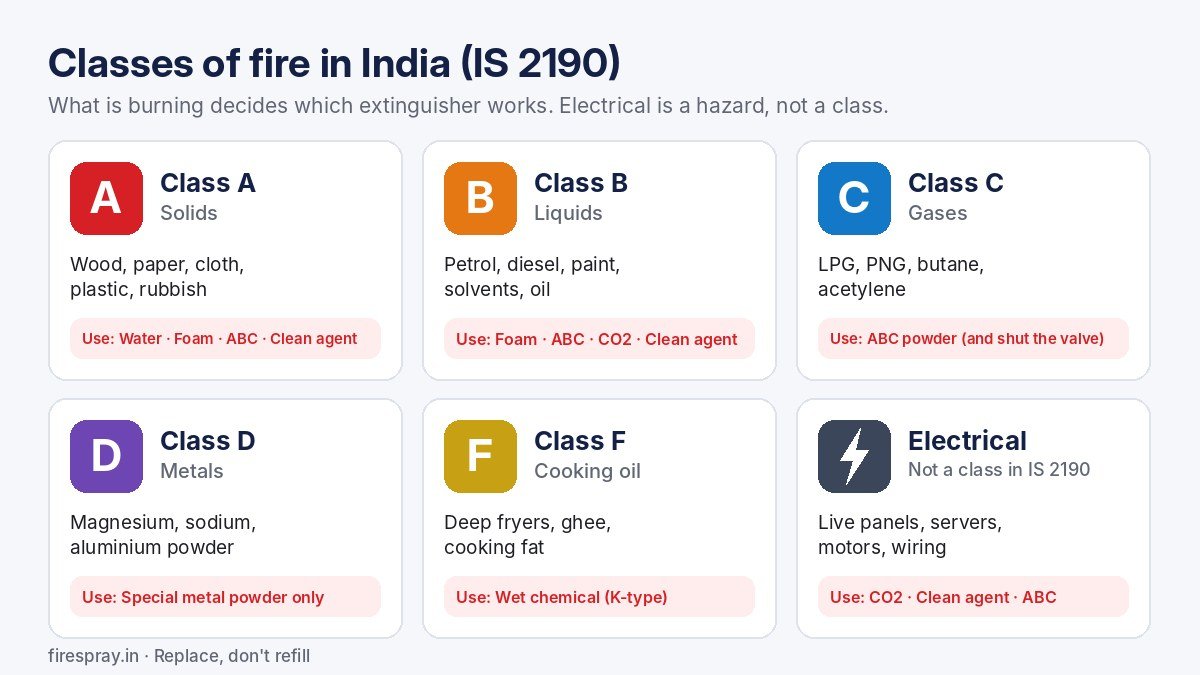
- Class A: solids. Wood, paper, cloth, plastic, rubbish, furniture. The most common fire in homes, schools and godowns.
- Class B: flammable liquids. Petrol, diesel, paint, thinner, solvents, lubricating oil. Garages, petrol pumps, paint shops, generator rooms.
- Class C: flammable gases. LPG, PNG, butane, acetylene. In India and Europe, Class C means gas. In the American system (NFPA), Class C means electrical. If you searched for a “Class C fire extinguisher” after reading a US website, you were probably looking for an electrical-safe extinguisher, which is covered below.
- Class D: metals. Magnesium, sodium, potassium, aluminium powder. Only found in specific industrial units, and they need a special metal-fire powder. None of the ordinary extinguishers on this page will put out a metal fire.
- Class F: cooking oil and fat. Deep fryers, ghee, tandoor oil, cooking fat in a commercial kitchen. Called Class K in the US. Needs a wet chemical extinguisher.
- Electrical equipment. Not a class of its own under IS 2190. Instead, an extinguisher label states whether the agent is safe to use on live electrical equipment. CO2, clean agent and ABC powder are. Water and foam are not.
The 7 fire extinguisher types and what each one is for
1. ABC dry powder (the all-rounder)
The red cylinder you see everywhere. It holds mono ammonium phosphate powder, usually at 90% strength (that is the “MAP 90” on a good label), pushed out by nitrogen. The powder smothers the fire and breaks the chemical chain reaction, so one cylinder covers Class A, B and C fires and is safe on electrical equipment too.
Where it belongs: flats, shops, offices, schools, societies, cars and small factories. If a building only has one kind of extinguisher, it is this one. Sizes run from 1 kg for a car to 9 kg for a factory floor, with 4 kg and 6 kg the standard picks for offices and societies.
The catch: powder goes everywhere. Discharge one 4 kg unit in a server room and you will spend a week cleaning fine dust out of every machine. That is why electrical rooms and data centres use CO2 or clean agent instead.
2. CO2 (carbon dioxide)
Liquid carbon dioxide stored under high pressure in a seamless steel cylinder. On discharge it comes out as a freezing white cloud that pushes oxygen away from the fire. It leaves no residue at all, which makes it the standard choice next to electrical panels, UPS rooms, server racks, labs and generators.
Rated for: Class B liquids and electrical equipment. It is not rated for Class A. The gas cools the surface, but paper and wood hold heat and re-ignite once the cloud disperses.
Good to know: the horn gets cold enough to cause frostbite, so hold the handle, never the horn. Common sizes are 2 kg and 4.5 kg, and a 4.5 kg CO2 unit is noticeably heavier than a 4 kg powder one because of the thick cylinder.
3. Foam (AFFF or mechanical foam)
Water mixed with a film-forming foam concentrate. The foam floats on a burning liquid, seals the surface and stops the vapour from feeding the flame. It also soaks into solids, so it is rated for Class A and Class B.
Where it belongs: petrol pumps, paint and solvent stores, workshops, diesel storage, transformer yards. The portable 6 and 9 litre units suit a garage or store room; the 25 to 100 litre trolley units are for fuel depots and factories.
Never on: live electrical equipment or cooking oil. Foam is mostly water.
4. Water
The oldest type, and still the right one for a pure Class A risk. A 9 litre water extinguisher throws a jet for several metres and cools burning wood, paper or cloth far better than powder does. It is cheap, simple and the discharge washes off.
Where it belongs: paper godowns, textile stores, timber yards, libraries, schools. Pair it with an ABC or CO2 unit if there is any electrical risk nearby, because water conducts electricity and must never be used on live equipment. Water mist versions use de-ionised water in a fine spray and are rated for some electrical use; check the label of the specific model.
5. Clean agent (HFC / HCFC gas)
A gas such as HFC-236fa or HCFC-123 stored as a liquid. It extinguishes by cooling and interrupting the reaction, evaporates completely and leaves nothing behind. Unlike CO2 it is rated for Class A as well as B and C, and it is safe on electrical equipment, so it is the one extinguisher that covers everything in an office without damaging anything.
Where it belongs: server rooms, data centres, hospitals, labs, control rooms, art and record stores, and anywhere a powder discharge would cost more than the fire. It costs more per kg than ABC powder, which is why it is used where the equipment is expensive, not everywhere.
6. Wet chemical (K-type) for kitchens
A potassium-based solution sprayed as a fine mist. On hot cooking oil it reacts to form a soapy crust that seals the surface and stops re-ignition, which no other agent does safely. Powder on a fryer fire works for a second and then the oil re-lights; water makes it explode out of the pan.
Where it belongs: every commercial kitchen: restaurants, hotel kitchens, canteens, cloud kitchens, mess halls, sweet shops with frying. Fire NOC inspections in most cities now look for a K-type extinguisher near the cooking line. It is rated for Class F and Class A. For a home kitchen, a fire blanket plus a small ABC unit is usually enough.
7. Lithium-ion battery extinguishers
The newest type, and the one most buildings do not have yet. A lithium-ion cell in thermal runaway makes its own oxygen, so powder and CO2 only knock down the flame while the cell keeps heating. A lithium-ion extinguisher uses an agent that cools the pack and forms a barrier over it, which is what actually stops the chain reaction spreading cell to cell.
Where it belongs: EV charging bays, two-wheeler parking with e-scooters, battery storage rooms, UPS and inverter rooms, mobile and laptop repair shops. If your society has an EV charger in the basement, this is the extinguisher that should be mounted next to it.
Also worth knowing: automatic units
Two more products do the same job without a person present. A modular (ceiling-mounted) extinguisher hangs above the risk, with ABC powder or clean agent inside, and a heat-sensitive bulb releases it at around 68 °C. These protect generator rooms, electrical rooms, store rooms and server racks after hours. A fire extinguisher ball works the same way at a smaller scale: it sits on a bracket or is thrown into a fire and bursts open in a few seconds. Both are supplements, not replacements. Your fire NOC still counts portable extinguishers.
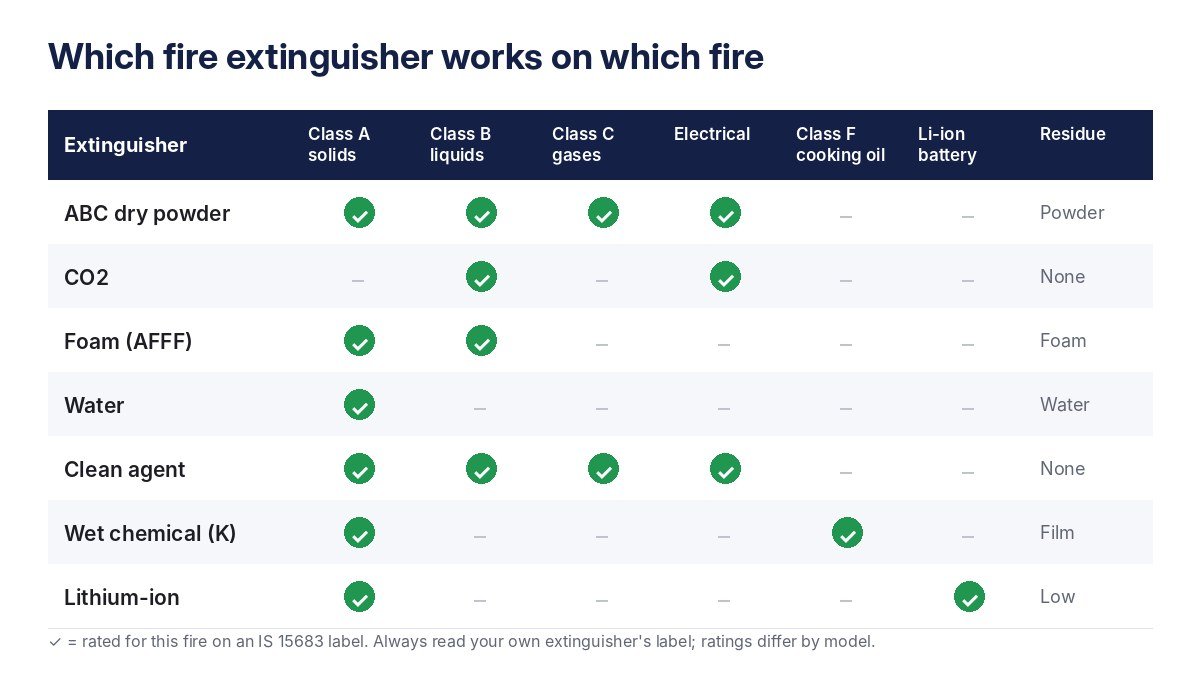
Which extinguisher works on which fire
| Extinguisher | Rated for | Not for | Residue | Typical sizes |
|---|---|---|---|---|
| ABC dry powder | A, B, C, electrical | Cooking oil, metals | Powder | 1, 2, 4, 6, 9 kg |
| CO2 | B, electrical | Class A on its own | None | 2, 4.5 kg |
| Foam | A, B | Electrical, cooking oil | Foam | 6, 9 L; 25 to 100 L trolley |
| Water | A | Electrical, liquids, oil | Water | 6, 9 L |
| Clean agent | A, B, C, electrical | Cooking oil, metals | None | 1, 2, 4, 6 kg |
| Wet chemical (K) | F, A | Electrical, liquids | Soapy film | 1 to 9 L |
| Lithium-ion | Li-ion battery, A | Liquids, gases | Low | 1 to 9 L |
How to choose for your place
- Flat or independent house: one 2 kg or 4 kg ABC powder unit near the kitchen door, and a 1 kg ABC in the car. Add a fire blanket for the kitchen.
- Shop or small office (up to about 1,000 sq ft): one 4 kg ABC near the exit. If there is a server, inverter or big electrical panel, add a 2 kg CO2 next to it.
- Office floor, clinic, showroom: 4 kg or 6 kg ABC units so that nobody walks more than 15 metres to reach one, plus CO2 or clean agent in the server and electrical rooms. IS 2190 sets the 15 metre travel distance for ordinary risks.
- Housing society: ABC units on every floor and in the lift lobby, CO2 at the meter room and generator, a lithium-ion unit at the EV charger, water or foam near the garbage and parking areas. The society page on bulk and project orders has a floor-by-floor example.
- Restaurant or canteen: a K-type at the cooking line, ABC at the exits, CO2 at the main panel.
- Factory or warehouse: depends on what is stored. Powder for general areas, foam for fuel and chemicals, CO2 or clean agent for panels and control rooms, and a 25 to 50 kg trolley unit where a fire could grow before the brigade arrives. A site visit is worth more than a guess; ask for one.
Two things matter more than the count. First, mount them where people can see and reach them: top of the handle no higher than 1.5 metres from the floor, never behind a door or inside a cupboard. Second, make sure someone knows how to use them. A 20-minute drill does more than a second extinguisher ever will; FireSpray runs free fire-safety training for societies and offices that buy from us.
How to read the label before you buy
An extinguisher sold in India should carry the ISI mark with the IS 15683 number and a CM/L licence number under it. Below the name you will find the fire rating, written like 2A 21B or 55B. The letter is the class and the number is how large a test fire that unit put out, so a 4 kg ABC rated 2A 21B and one rated 1A 13B are not the same product even if they look identical. The label also states the agent and quantity (for example “MAP 90%, 4 kg”), the operating pressure, the manufacturing date, and whether it is safe on electrical equipment up to a stated voltage. If any of those are missing, the cylinder is not what the inspector will accept. Every FireSpray unit ships with this label, a pressure test and a 5-year warranty in writing.
Sealed, refilled, or expired?
Powder cakes, seals dry out and pressure drops, so a stored-pressure extinguisher has a working life. In India the usual cycle is a visual check every month, a service once a year, and a hydraulic pressure test of the cylinder every 3 years for powder and every 5 years for CO2. Many buildings instead pay a refiller to empty and refill the same cylinder every year, often without any pressure test, and the sticker is the only thing that changes. We think that is a poor deal for the buyer, which is why FireSpray sells sealed new units at a factory price rather than a refilling service. The refill vs replace page walks through the cost over 5 years with real numbers.
Frequently asked questions
How many types of fire extinguisher are there?
Seven types are in common use in India: ABC dry powder, CO2, foam, water, clean agent, wet chemical (K-type) and lithium-ion. Metal-fire (Class D) powder makes an eighth for specialised industry. Older types such as soda-acid and halon are no longer made or permitted.
What are the 4 types of fire extinguishers?
The “four types” people usually mean are water, foam, dry powder and CO2. That list dates from before clean agent, wet chemical and lithium-ion extinguishers existed, and it is still what most school textbooks teach. For a building today, the seven types above are the practical list.
Which fire extinguisher is used for electrical fire?
CO2 or clean agent, because both are non-conductive and leave no residue on the equipment. ABC powder is also rated safe on electrical equipment and will put the fire out, but the powder has to be cleaned off everything afterwards. Never water or foam.
Is Class C electrical?
Only in the American NFPA system. In India under IS 2190, and in Europe, Class C means flammable gases such as LPG. Electrical equipment is treated as a hazard that each extinguisher is or is not rated for, and the label tells you which.
Which fire extinguisher is best for home?
A 2 kg or 4 kg ABC dry powder unit. It covers the solids, liquids and electrical risks found in a home, costs the least and is simple to use. Add a fire blanket for the kitchen and a 1 kg ABC for the car.
What is the difference between ABC and CO2 fire extinguishers?
ABC powder covers Class A, B, C and electrical fires and leaves a powder residue. CO2 covers Class B and electrical only, leaves no residue and is the better choice next to electronics. Most offices use both: ABC in the corridors, CO2 in the server and electrical rooms.
Which extinguisher does a fire NOC need?
The fire officer checks that the type matches the risk and that the count and placement follow IS 2190. In practice that means ABC powder across the floor, CO2 or clean agent at electrical and server rooms, K-type at a commercial kitchen, and ISI-marked units with a valid label and date. Requirements vary by state and occupancy, so confirm with the local fire office or your architect.
Standards referenced: IS 2190 (selection, installation and maintenance of portable first-aid fire extinguishers) and IS 15683 (portable fire extinguishers, performance and construction), both published by the Bureau of Indian Standards. For fire NOC rules in Maharashtra see the Maharashtra Fire Services site.
Not sure which one you need? Send us a photo of the room on WhatsApp and we will tell you what to mount and where, or see the full price list for every type and size.