
Every housing society committee asks the same question sooner or later, usually after a fire NOC inspection, an insurance renewal or a small fire in the parking: how many fire extinguishers does our society actually need, which type, and where do they go?
This guide gives you a simple way to count them for your own towers, floors and parking, with a worked example for a typical Indian society. The common areas (lobbies, staircases, parking, meter rooms, pump room, clubhouse) are the society’s responsibility; flats are each owner’s.
The rules behind the numbers
In India, the selection and placement of portable extinguishers follows IS 2190, and the fire safety chapter of the National Building Code (NBC Part 4) sets what a residential building needs. Your local fire department applies these when it issues or renews the fire NOC, and high-rise towers usually need hydrants and sprinklers as well. In practice, three simple rules decide the count:
- Floor area. Plan roughly one 6 kg ABC unit for every 200 square metres of common floor area, and at least one on every floor.
- Walking distance. Nobody should have to walk more than about 15 metres to reach an extinguisher.
- The right type for the risk. ABC powder for general areas, CO2 for electrical rooms, K-type wherever there is a kitchen, and a lithium-ion unit where e-scooters and EVs charge.
The fire department’s inspection and your NOC conditions are final; if they ask for more, go with them.
How to count for your society
- Floors: one ABC 6 kg per floor per tower, at the lift lobby or next to the staircase. Large floors with long corridors need two.
- Ground lobby: one ABC 6 kg per tower lobby.
- Parking: two ABC 6 kg per parking level per tower, on pillars near ramps and exits. Big open basements are better covered by automatic modular units on the ceiling as well.
- Electrical and meter rooms: one CO2 4.5 kg per tower meter room, and one for the main LT panel room.
- Plant rooms: DG set room: one CO2 and one ABC. Pump room: one ABC. Lift machine room: one CO2.
- Clubhouse: ABC units near the exits of the gym, hall and pool area, and one K-type wherever food is cooked.
- EV and e-scooter charging: a lithium-ion extinguisher next to the charging points, plus a ceiling unit if the charging area is in a closed basement.
Worked example: 3 towers, 12 floors
Take a society with 3 towers of 12 floors each, one basement parking level, a DG set, a pump room and a clubhouse with a small pantry.
| Area | Type | Count |
|---|---|---|
| Floors (3 towers × 12 floors) | ABC 6 kg | 36 |
| Ground lobbies | ABC 6 kg | 3 |
| Basement parking (2 per tower) | ABC 6 kg | 6 |
| Meter rooms and LT panel room | CO2 4.5 kg | 4 |
| Lift machine rooms | CO2 4.5 kg | 3 |
| DG set room | CO2 4.5 kg + ABC 6 kg | 2 |
| Pump room | ABC 6 kg | 1 |
| Clubhouse, gym and hall | ABC 6 kg | 2 |
| Clubhouse pantry | K-type | 1 |
| EV and e-scooter charging | Lithium-ion | 1 |
| Total | 59 |
That is roughly 49 ABC, 8 CO2, 1 K-type and 1 lithium-ion unit. A society with larger floor plates, two basements or a big clubhouse will need more. To get your own count in seconds, use the calculator on our housing society fire extinguisher page.
Where and how to mount them
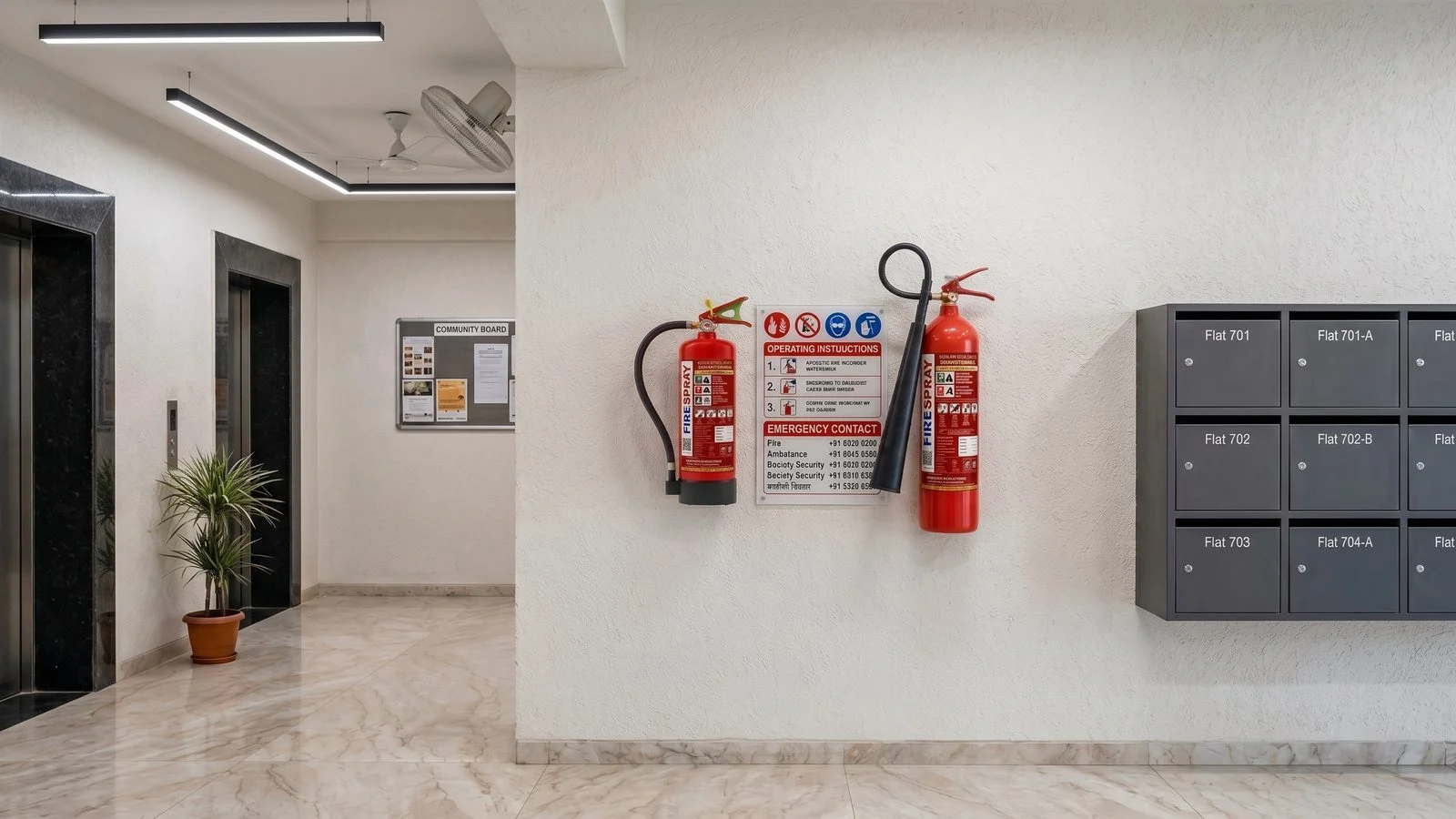
- Mount on a wall bracket or in a box so the handle is no higher than about 1.5 metres from the floor and easy for anyone to lift.
- Place them on the escape route, near the staircase or exit, not deep inside a room where a fire could block the way.
- Keep them visible and unblocked: no shoe racks, plants, bicycles or stored furniture in front.
- Put a signage sticker above each unit so it can be found in smoke.
- In parking, keep them away from the ramp’s vehicle path so cars cannot hit them, and use a box or cover where they face rain or dust.
Which type for which area
| Area | Best choice | Why |
|---|---|---|
| Lobbies, corridors, staircases | ABC 6 kg | Covers wood, paper, cloth, fuel and live electrical fires. |
| Parking | ABC 6 kg, plus modular on the ceiling | Vehicle fuel and wiring; the ceiling unit works when nobody is there. |
| Meter, panel and lift machine rooms | CO2 4.5 kg | Leaves no residue on meters, panels and electronics. |
| DG set room | CO2 and ABC | CO2 for the panel, ABC for diesel and general fires. |
| Clubhouse kitchen or pantry | K-type | Cooking oil fires need wet chemical; powder can splash burning oil. See our kitchen extinguisher guide. |
| EV and e-scooter charging | Lithium-ion | Battery fires relight; see our lithium battery fire guide. |
Keeping them ready
- Every month: the security supervisor checks that each unit is in place, the pressure gauge needle is in the green and the safety pin and seal are intact. Keep a simple register.
- Every year: a full inspection by a trained technician, with the date on each unit’s tag.
- After any use, even a short burst: refill it. A partly used unit can lose pressure.
- Training: guards and housekeeping staff should practise the PASS method (pull, aim, squeeze, sweep) at least once a year. We run free fire safety training for societies that order with us.
Frequently asked questions
How many fire extinguishers are required per floor in a residential building?
At least one ABC 6 kg unit per floor of every tower, near the lift lobby or staircase. A large floor or a long corridor needs two, so that nobody walks more than about 15 metres to reach one.
Which fire extinguisher is best for a housing society?
ABC 6 kg is the main unit for lobbies, staircases and parking. Add CO2 4.5 kg for meter, panel and lift machine rooms, K-type for any kitchen and a lithium-ion unit near EV and e-scooter charging.
How many fire extinguishers does a basement parking need?
Plan about two ABC 6 kg units per parking level per tower, near the ramps and exits. Large closed basements are better protected with automatic modular units on the ceiling as well.
Is a fire extinguisher compulsory in a housing society?
Yes. The National Building Code and state fire rules require fire safety equipment in the common areas, and the fire department checks it for the fire NOC. Insurance claims can also be affected if the equipment is missing or expired.
Who is responsible for fire extinguishers in a society?
The society committee is responsible for the common areas: lobbies, staircases, parking, plant rooms and the clubhouse. Each flat owner is responsible for their own home.
How often should society fire extinguishers be checked?
A quick visual check every month by the security team and a full inspection by a trained technician every year. Refill any unit after use or if the gauge is out of the green.