
Most home fires in India start in the kitchen, and most kitchen fires start the same way: oil left on a high flame for “just one minute”, a kadhai of puri oil that catches when the phone rings, a tadka that flares into the chimney filter. Oil at frying temperature can burst into flame on its own, and once it does, the two things people reach for first, a mug of water and the nearest extinguisher, are often the two that make it worse.
This guide explains why a cooking oil fire is different, which extinguisher is rated for it in India, what a home kitchen, a restaurant and a canteen should actually keep, and the one thing you must never do with burning oil.
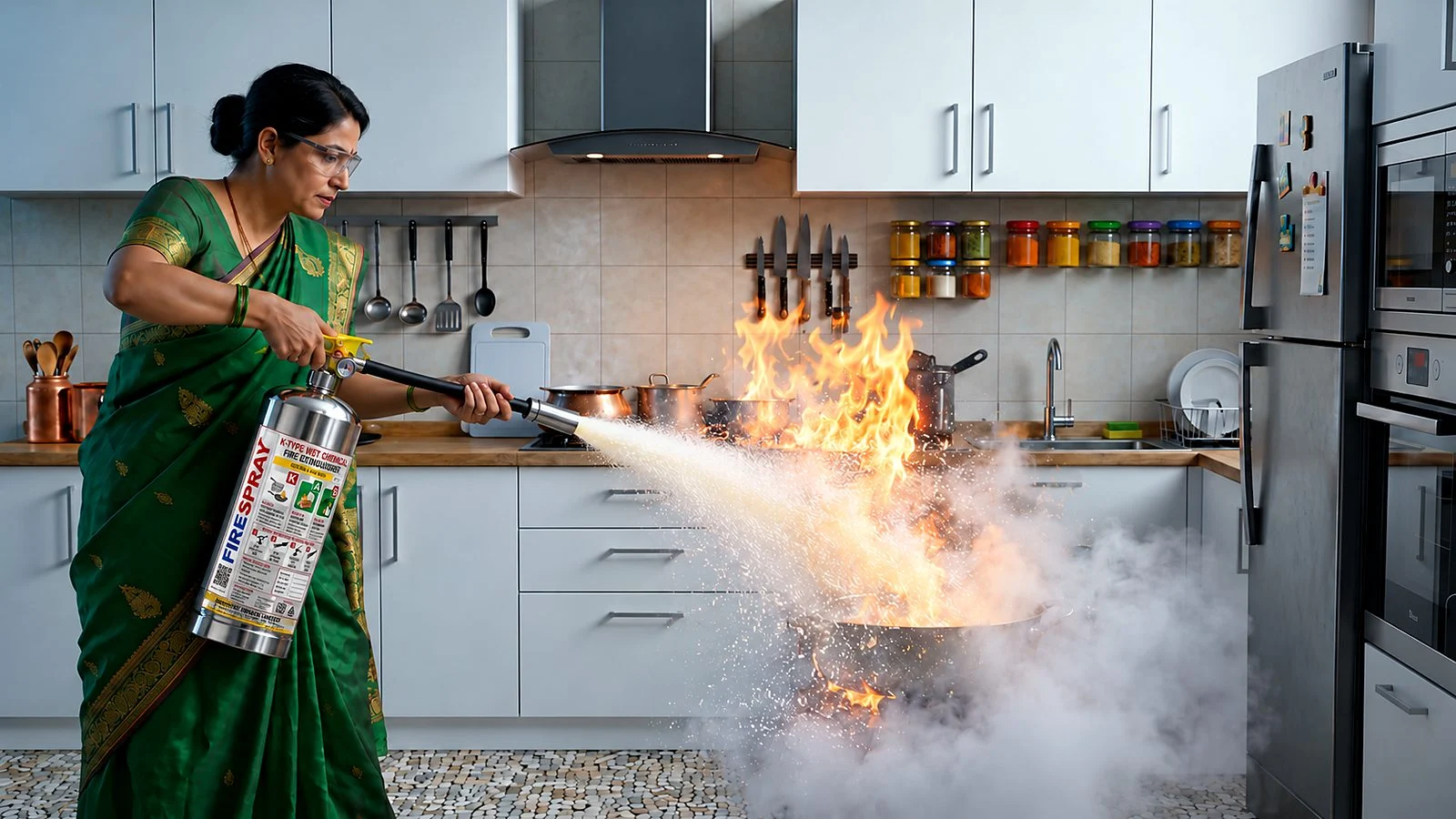
Why a cooking oil fire is different
Cooking oil does not behave like paper or wood. Sunflower, mustard and groundnut oil start to smoke at around 230 °C and can ignite on their own at about 350 °C, with no spark needed. Knock the flame down and the oil is still hot enough to light again a few seconds later. That is why IS 2190 gives cooking oil fires their own class, Class F (called Class K in the American system, which is where the name “K-type” comes from).
To stop a Class F fire for good you have to do two things at once: cut off the air from the surface and bring the oil temperature down below the point where it relights. An ordinary extinguisher does the first part. Only a wet chemical extinguisher is designed to do both.
Never water on an oil fire
Water is heavier than oil and boils at 100 °C. Poured into a pan at 300 °C it sinks, turns to steam in a fraction of a second and throws the burning oil out of the pan as a ball of fire, often onto the person holding the mug and up into the chimney. A single glass of water can turn a pan fire into a kitchen fire. The same goes for a wet cloth thrown loosely over the pan, a water-type extinguisher and a foam extinguisher that is not rated for Class F.
What to do in the first ten seconds
- Turn off the gas at the knob, and at the cylinder regulator or PNG valve if you can reach it safely. A fire with no fuel feeding it stays small.
- Do not move the pan. Carrying burning oil to the sink or out of the door is how most kitchen burn injuries happen.
- Smother or extinguish: cover a small pan fire with a fire blanket or a tight metal lid, or use a K-type extinguisher from about two metres away.
- Leave it covered for at least 30 minutes. Lifting the blanket or lid to check lets air back onto oil that is still hot enough to relight.
- Get out and call 101 if the fire has reached the chimney, the cabinets or the ceiling. Close the kitchen door behind you.
Which extinguisher for a kitchen
1. K-type (wet chemical): the right one for cooking oil
A K-type kitchen fire extinguisher holds a potassium-based wet chemical solution. Sprayed gently onto burning oil, it reacts with the hot fat and forms a thick, soap-like layer on the surface (the chemists call it saponification). That layer seals the oil from the air, and the water in the solution cools the oil underneath, so the fire does not come back. FireSpray K-type units are rated for Class A and Class K, so the same unit also handles a burning cloth, chopping board or cabinet door.
Use it from about two metres, aim at the back of the pan and let the spray fall onto the oil rather than blasting it, which could splash the oil. Two versions are available: the red mild steel K-type for working restaurant and canteen lines, and the stainless steel K-type for open hotel kitchens and modular home kitchens, where it stays rust-free in steam and grease.
2. ABC dry powder: good for the rest of the house, not for the kadhai
An ABC extinguisher is the right first unit for a home: it covers furniture, LPG and electrical fires. On burning oil it will knock the flames down, but it does not cool the oil, so a deep pan can relight once the powder settles, and the force of the discharge can splash oil out of the pan. It also leaves fine powder over every surface and inside the chimney. Keep the ABC outside the kitchen door for everything else, and use a K-type or a fire blanket on the cooking range.
3. CO2: not for a cooking fire
A CO2 extinguisher is excellent next to an electrical panel, but on a pan of oil the gas disperses in seconds and the oil, still hot, relights. The high-pressure jet can also push burning oil out of the pan. A CO2 unit belongs with the kitchen’s electrical board, not at the stove.
4. Fire blanket: the fastest tool for a small pan fire
For a single pan on a home stove, a fire blanket is often quicker than any extinguisher. Pull the tapes, hold the blanket in front of you with your hands tucked behind it, lay it over the pan from the front, turn off the gas and leave it. Mount it on the wall beside the cooking range, not above it, so you never reach over the flame to get it. A blanket is single-use for a fire; replace it once it has been used.
5. Fire ball: cover for when nobody is there
A fire ball mounted near the range bursts when flames reach it and covers the area with powder. It is useful in a kitchen that is often left unattended, such as a store kitchen or a pantry, but it does not replace an extinguisher or a blanket that someone can use.
Kitchen fire extinguishers compared
| Type | Burning cooking oil | Rest of the kitchen | Notes |
|---|---|---|---|
| K-type (wet chemical) | Yes, rated for it | Yes, also rated Class A | Seals and cools the oil; the standard for restaurants |
| Fire blanket | Yes, small pan fires | Clothing on a person | Fastest for one pan on a home stove |
| ABC dry powder | Knocks it down, can relight | Yes: furniture, gas, electrical | Keep outside the kitchen door; messy cleanup |
| CO2 | No, oil relights | Electrical board only | High-pressure jet can splash oil |
| Water or foam (not F-rated) | Never | Solids only | Causes a steam explosion of burning oil |
What to keep where
| Kitchen | Keep | Where |
|---|---|---|
| Home kitchen (flat or house) | 1 or 2 L K-type, or a fire blanket; plus a 2 or 4 kg ABC for the house | K-type or blanket beside the range; ABC outside the kitchen door |
| Modular or open kitchen | 2 L stainless steel K-type and a fire blanket | On the wall near the exit side of the kitchen |
| Restaurant, dhaba, cloud kitchen | 6 or 9 L K-type per cooking line; ABC near the exit; CO2 by the electrical board | Within a few steps of every fryer and tandoor, never behind them |
| Hotel, hostel, hospital or factory canteen | K-type at each cooking range, fire blankets, ABC in the corridor | Plus a kitchen hood suppression system for large lines |
| Housing society clubhouse or pantry | 2 L K-type and a fire blanket | Part of the society fire safety kit |
Mount every unit on the exit side of the kitchen, so that you face the fire with the door behind you. IS 2190 asks for the top of the handle at no more than 1.5 metres from the floor. Make sure the cook, not just the owner, knows where the unit is and has held it once.
Six habits that prevent most kitchen fires
- Never leave oil on the flame and walk away, even for a minute. If you have to leave, switch off the gas.
- Fry in a deep, heavy pan, filled no more than a third, so oil cannot boil over onto the burner.
- Clean the chimney filter regularly; a filter full of old grease is fuel sitting above the flame.
- Check the LPG hose for cracks and change it on schedule; turn the regulator off at night.
- Keep dish towels, plastic containers and curtains away from the burners.
- Do not run the microwave, induction and geyser on one extension board.
Frequently asked questions
Which fire extinguisher is best for a kitchen?
A K-type (wet chemical) fire extinguisher, because it is the type rated for cooking oil fires. It seals the burning oil and cools it so it does not relight. For a home, a 1 or 2 L K-type or a fire blanket beside the range, with an ABC extinguisher outside the kitchen door, covers most risks.
Can I use an ABC fire extinguisher in the kitchen?
Yes for most kitchen fires, such as a burning cloth, a cabinet or an LPG leak fire. On a pan of burning oil it knocks the flames down but does not cool the oil, so the oil can relight, and the discharge can splash it. Use a K-type or a fire blanket on cooking oil.
What is a K-type fire extinguisher?
It is a wet chemical extinguisher made for cooking oil and fat fires (Class F in India, Class K in the American system). The solution reacts with hot oil to form a soap-like layer that cuts off air and cools the oil underneath.
Why should you never use water on an oil fire?
Water sinks under the hot oil, turns to steam instantly and throws burning oil out of the pan as a fireball. Turn off the gas and cover the pan with a fire blanket or a metal lid, or use a K-type extinguisher.
Which size of kitchen fire extinguisher do I need?
A 1 or 2 L K-type is enough for a home kitchen. Restaurants and canteens usually keep a 6 or 9 L K-type for each cooking line, plus ABC and CO2 units for the rest of the premises.
Is a fire blanket enough for a home kitchen?
A fire blanket is the quickest way to put out a small pan fire, and many homes keep one beside the stove. It does not help once the fire has spread to cabinets or the chimney, so keep an extinguisher in the house as well.
Standards referenced: IS 2190 and IS 15683 from the Bureau of Indian Standards. In an emergency, call the fire service on 101.
Not sure what your kitchen needs? Send a photo of the cooking area on WhatsApp and we will suggest what to mount and where, or see every kitchen fire extinguisher with live prices.