
Most people in India have walked past a fire extinguisher every day of their working lives and never touched one. Then a dustbin, a toaster or a two-wheeler catches fire and they discover that the pin does not come out the way they expected, the discharge lasts far less time than they thought, and they were standing too close. None of this is hard. It just needs to be seen once before the day it matters.
This guide walks through how to use a fire extinguisher step by step with the PASS method, what to decide before you pick it up, how CO2, powder, foam and kitchen units differ in the hand, and what to do afterwards. It takes five minutes to read and is the same drill we teach in our free fire-safety training for societies and offices.
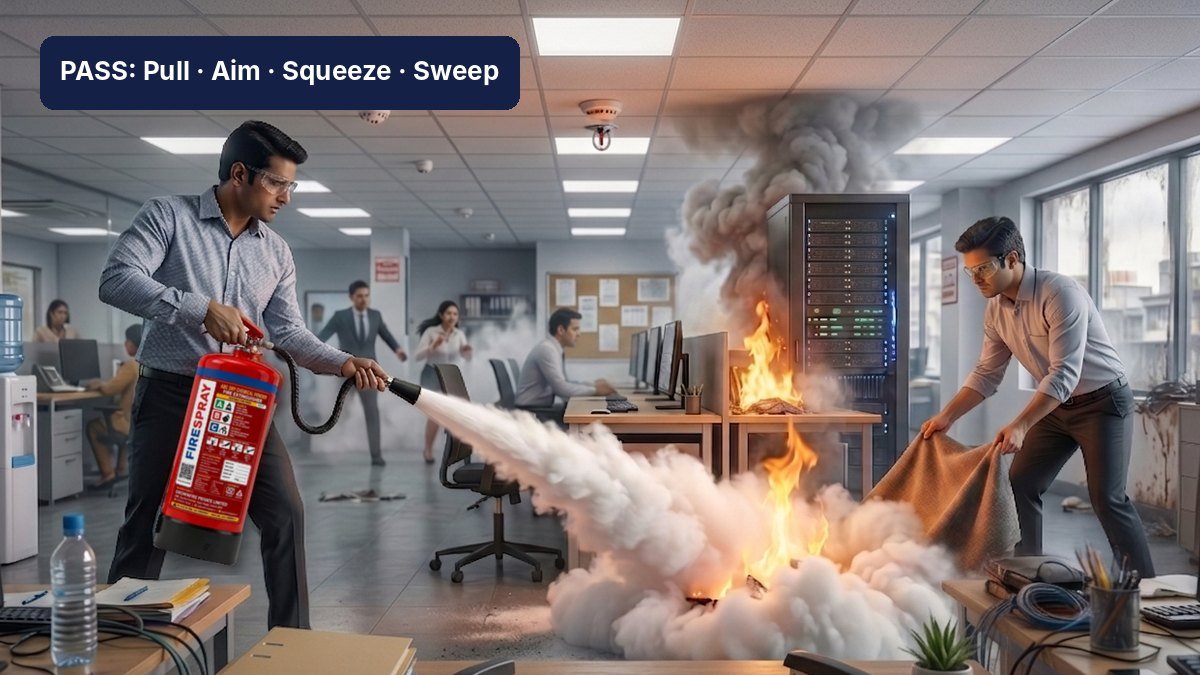
Before you touch the extinguisher: three decisions
- Raise the alarm first. Shout “fire”, press the alarm if there is one, and have someone call 101 or 112 while you deal with the extinguisher. A fire brigade that is already on its way costs nothing if you put the fire out yourself.
- Is it small enough? A portable extinguisher is for a fire you could cover with a bedsheet: a bin, a pan, a motor, a sofa cushion, a single machine. If the flames are taller than you, the room is filling with smoke, or the fire has reached the ceiling, it is past the stage an extinguisher can handle. Close the door on it and get out.
- Where is your way out? Stand so the exit is behind you and the fire is in front. Never let the fire get between you and the door. If you have to move around the fire to reach the extinguisher, you are already on the wrong side of it.
Fire services teach this sequence as RACE: Rescue anyone in immediate danger, Alarm, Confine the fire by closing doors and windows, then Extinguish or Evacuate. The extinguisher comes last for a reason.
The PASS method: Pull, Aim, Squeeze, Sweep
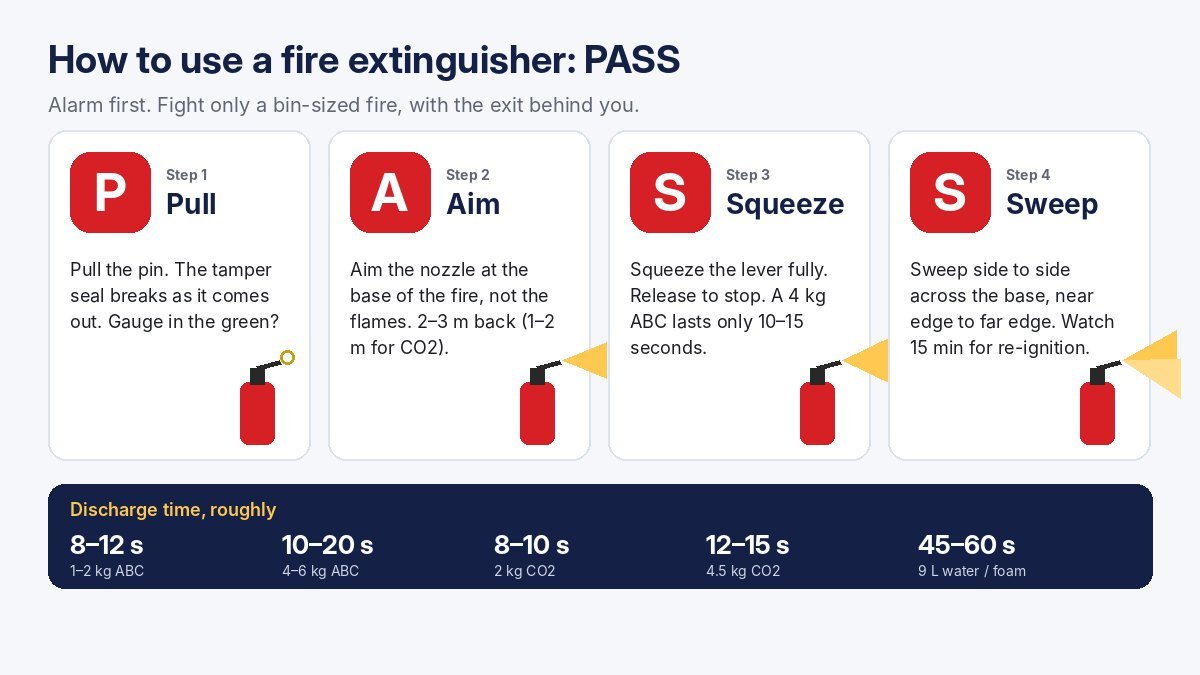
P: Pull the pin
Hold the extinguisher upright by the carrying handle. Twist and pull the safety pin out of the top of the valve; it is held by a thin plastic or wire tamper seal that breaks as you pull. On a stored-pressure unit, look at the gauge as you do this: the needle should be in the green. On a CO2 unit there is no gauge; weight is the check, and that is done at the monthly inspection, not now.
A: Aim at the base of the fire
Point the nozzle or hose at the bottom of the flames, where the fuel is, not at the flames themselves. Stand 2 to 3 metres back for a powder, foam or clean agent unit; closer, about 1 to 2 metres, for CO2 because the gas disperses fast. If the fire is in a bin or a tray, aim at the near edge rather than blasting the centre, which can throw burning material out.
S: Squeeze the lever
Squeeze the operating lever down fully against the carrying handle. The discharge starts immediately and continues as long as you hold it. Let go and it stops; you do not have to empty the unit in one go. A 4 kg ABC powder unit discharges in roughly 10 to 15 seconds; a 2 kg CO2 unit in about 8 to 10 seconds; a 9 litre water or foam unit in 45 to 60 seconds. That is less time than most people expect, so do not waste the first two seconds on the flames.
S: Sweep side to side
Move the nozzle slowly from side to side across the base of the fire, working from the near edge to the far edge. As the flames die back, move in closer and keep sweeping until the fire is out and nothing is glowing. Then stop, step back and watch it. Keep the extinguisher ready; re-ignition in the first minute is common, especially with powder on a hot liquid.
What changes with each type of extinguisher
- ABC dry powder: the cloud blocks your view for a moment. Sweep steadily and do not stop just because you cannot see flames through the powder. Expect to clean powder off everything afterwards. Rated A, B, C and safe on electrical equipment up to the voltage on the label.
- CO2: hold the handle, never the horn, which frosts within seconds and can tear skin. The discharge is loud. In a small closed room, step out once the fire is out; a full discharge displaces breathable air. On a 4.5 kg CO2 with a wheel valve, you open the valve anticlockwise instead of squeezing a lever.
- Foam: on a liquid fire, let the foam fall gently on the surface and spread. Do not fire a hard jet into the liquid. On a solid fire, aim at the base as usual. Never on live electrical equipment.
- Water: only for wood, paper, cloth and rubbish. Aim the jet at the base and keep it there until the material is soaked, not just dark. Never on oil or live equipment.
- Wet chemical (K-type), kitchen: turn the gas off. Stand back, hold the lance high and let the mist fall onto the burning oil in slow passes. A hard jet into a fryer splashes burning oil. Keep applying after the flames are out so the soapy layer seals the surface.
- Clean agent: same as powder in technique, but you see the fire clearly throughout and there is nothing to clean afterwards. Keep sweeping for a second or two after the flames go.
- Fire blanket: for a pan or a person. Hold it by the corners with your hands tucked behind it, lay it over the pan away from you, turn the heat off and leave the blanket on for 30 minutes. Never lift it to check.
- Fire extinguisher ball: throw or roll it into the fire; it bursts open in a few seconds and spreads powder. It is a supplement for places nobody can reach, not a substitute for a portable unit.
After the fire is out
- Keep watching the spot for at least 15 minutes, with the extinguisher in hand, even if it looks out. Embers in paper, cloth and cable insulation relight.
- Ventilate the room: open windows, and if a CO2 unit was used, stay outside until the air has cleared.
- Tell the fire brigade it is out if they are on their way; do not cancel them before you are sure.
- Take the used extinguisher out of service. A partly used stored-pressure unit loses its pressure through the valve within hours and will not work next time. Tag it, and replace or refill it before it goes back on the wall.
- Write down what burned and why. Most small fires in offices and societies come from the same handful of causes, and the next one is preventable.
Practise once a year
The reason extinguisher drills exist is that the first time you pull the pin should not be during a fire. Pick one unit that is due for replacement, take it outside, light a small fire in a metal tray and let three or four people put it out. It takes ten minutes, costs one extinguisher and the next fire in that building gets handled by someone who has done it before. We run this drill free for societies and offices that buy from us; ask for a date.
Keep it ready: the monthly check
An extinguisher only works if it is where it should be and still charged. Once a month: it is on its hook or stand, nothing is stacked in front of it, the pin and tamper seal are in place, the gauge needle is in the green, the hose and nozzle are clear, the label is readable and the date is within its service life. If any of those fails, it goes out of service that day. Read the guide to fire extinguisher types if you are not sure the units you have are the right ones for the room.
Frequently asked questions
What does PASS stand for in fire extinguisher use?
Pull the pin, Aim at the base of the fire, Squeeze the lever, Sweep from side to side. It is the standard four-step method taught worldwide and in every Indian fire-safety course.
What is the full form of RACE in fire safety?
Rescue, Alarm, Confine, Extinguish (or Evacuate). It is the order of actions when a fire is found: get people out of immediate danger, raise the alarm, close doors to confine the fire, then fight it if it is small or leave if it is not.
How far should you stand from a fire when using an extinguisher?
About 2 to 3 metres for powder, foam, water and clean agent units, and 1 to 2 metres for CO2. Start at that distance and move in as the fire dies down.
How long does a fire extinguisher last when discharged?
A 1 kg or 2 kg ABC unit empties in 8 to 12 seconds, a 4 to 6 kg unit in 10 to 20 seconds, a 2 kg CO2 in about 8 to 10 seconds, and a 9 litre water or foam unit in roughly a minute. Aim before you squeeze.
Can you use a fire extinguisher more than once?
You can release the lever and squeeze again during the same fire. But a stored-pressure unit that has been partly used will not hold pressure afterwards and must be replaced or refilled before it goes back on the wall, even if it still feels heavy.
Which way do you aim a fire extinguisher?
At the base of the fire, where the fuel is burning, not at the flames above it. Sweep across the base from the near edge to the far edge.
Should I fight the fire or leave?
Fight it only if it is small (bin-sized), you have a clear exit behind you, the right type of extinguisher is in your hand and the alarm has been raised. If any one of those is missing, close the door and leave.
Method as taught in IS 2190 and by state fire services; emergency numbers 101 (fire) and 112 (all emergencies) work across India.
Want a drill at your office or society? Book free training, or send us a photo of your extinguishers on WhatsApp and we will tell you whether they are the right type and still in date.